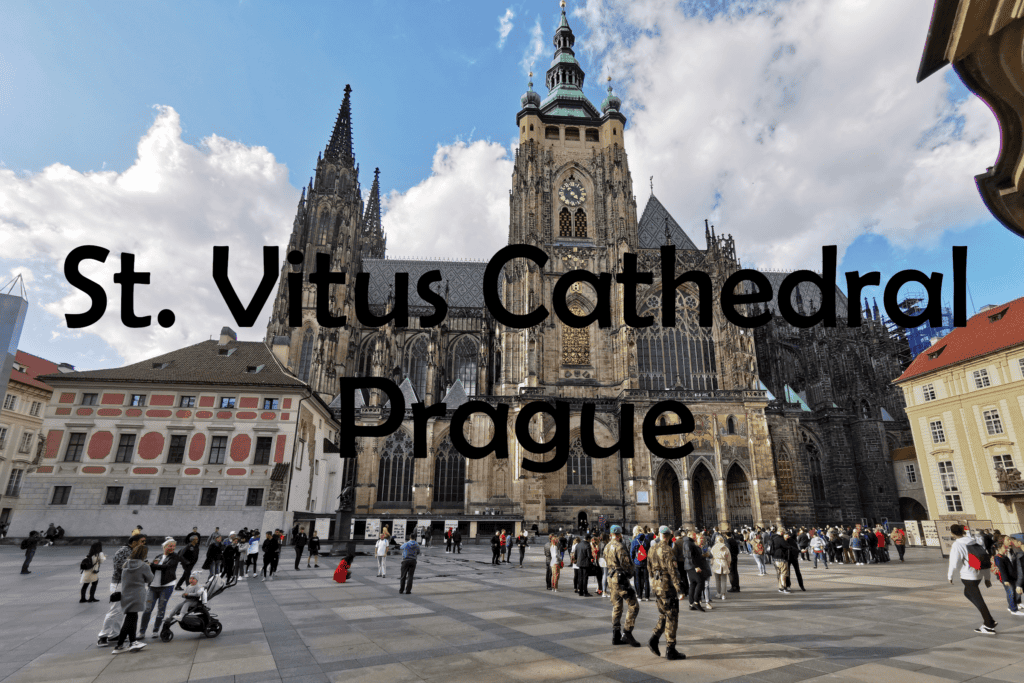
St. Vitus Cathedral at Prague Castle is one of Prague’s most impressive monuments. A visit to this magnificent cathedral is a must on any trip to Prague. In this article, you will learn everything you need to know when visiting St. Vitus Cathedral.
St. Vitus Cathedral tickets
In the past, it was possible to visit a designated part of the cathedral for free, but this part is currently closed due to construction work. You can only enter St. Vitus Cathedral with a ticket.
A visit to St. Vitus Cathedral is part of the Main Visitor Route (Hlavní okruh) at Prague Castle. An adult ticket costs CZK 450 and includes admission to the cathedral, the Old Royal Palace, Golden Lane, and St. George’s Basilica. It is not possible to purchase a separate ticket for St. Vitus Cathedral only.
There is a separate entrance to the cathedral’s Great South Tower, which allows you to climb steep stairs to the tower for one of the most beautiful views of Prague. A ticket to the tower costs CZK 200.
Tickets for the Main Route of Prague Castle can be purchased at this link.
St. Vitus Cathedral Prague opening times
St. Vitus Cathedral is open every day of the week from 9:00 a.m. to 5:00 p.m. (from November to March only until 4:00 p.m.). On Sundays, the cathedral opens at 12:00 p.m.
What to see in St. Vitus Cathedral
Immediately upon entering the main nave of the cathedral, you will be impressed by how imposing and enormous the cathedral is. It is the main nave that usually attracts the largest number of visitors, but it is the Chapel of St. Wenceslas that hides the real treasures.
It was built over the tomb of St. Wenceslas, the patron saint of the Czech lands. In the chapel, you may also notice a closed door on the right-hand side. This leads to the strictly guarded Crown Chamber, where the Czech crown jewels are stored. And why does the door have seven locks? Because there are seven unique keys. Each of them is kept by an important Czech figure, such as the President of the Republic or the Mayor of Prague.
When you leave the chapel, take a look at the beautiful wood carvings depicting the history of the cathedral. Among other things, you will also see several tombs – St. John of Nepomuk, for example, is buried here. You should also note the striking Golden Gate, above which you will see a mosaic of the Last Judgment. In the past, this gate served as the official entrance to the cathedral, but today it is used only on special occasions.
When you leave the cathedral and walk around it on the right side, you will also reach the entrance to the Great south tower. You can climb it with a separate ticket and enjoy beautiful views of Prague. In the tower, you will also notice seven bells – the largest of which is the largest bell in the Czech Republic.
How to get to St. Vitus Cathedral?
St. Vitus Cathedral is part of the Prague Castle complex, so you can get there the same way you get to the castle. The closest stop to the cathedral is Prague Castle, which is served by trams 22 and 23.
If you don’t mind climbing stairs, you can take the metro line A to the Malostranská station and walk to the cathedral in about 10 minutes. Another pleasant option is to walk downhill from the Pohořelec stop, which is served by tram lines 22 and 23.
History of St. Vitus Cathedral Prague
St. Vitus Cathedral is a symbol of Czech statehood and one of the most distinctive buildings in Prague. It stands on a site that has been a spiritual center since the early Middle Ages, when the first rotunda dedicated to St. Vitus was built here. It was gradually replaced by a Romanesque basilica, and with the growing importance of the Czech state, a more representative building became necessary. This is where the story of the monument, which took centuries to build, begins.
A major turning point came in the 14th century, when Prague became the seat of the Roman emperor. The new Gothic cathedral was to reflect the ambitions of the kingdom and the entire empire – it was to be a coronation church, the final resting place of rulers, and the spiritual heart of the country. The building was designed to be magnificent, with high vaults, rich stonework, and an elaborate system of buttresses. Even then, it was clear that this would not be a project for a single generation.
However, construction was repeatedly interrupted by wars, lack of funds, and political upheavals. For a long time, the unfinished cathedral consisted only of part of today’s nave and south tower. Nevertheless, it became the place of coronation of Czech kings and the repository of the crown jewels, which are still hidden in the Crown Chamber above St. Wenceslas Chapel. This chapel, decorated with semi-precious stones and murals, is one of the most valuable parts of the entire cathedral.
The idea of completing the cathedral in its original spirit was revived in the 19th century during the National Revival. The cathedral was seen as a symbol of the historical continuity of the Czech state, and so a long and demanding completion in the Neo-Gothic style began. The architects tried to follow the medieval part as closely as possible so that the whole would appear uniform. The cathedral was not ceremoniously completed until the 20th century, almost six hundred years after the foundation stone was laid.
St. Vitus Cathedral – interesting facts
And finally, a few interesting facts that will make your visit to the cathedral even better:
- The Crown Chamber above St. Wenceslas Chapel houses the Czech crown jewels, including the Crown of St. Wenceslas. The chamber has seven locks, and the keys are held by seven prominent figures from the state and the church.
- The largest bell in the cathedral is called Zikmund (after one of the Czech kings) and is the largest bell in Czechia. It is only rung on special occasions.
- There are 287 steps leading up to the viewing gallery in the south tower. Once you have climbed them, you will find yourself at a height of 56 meters.
What to see around St. Vitus Cathedral?
When you visit Prague Castle, you should definitely visit other parts of the complex as well. Be sure to visit the Old Royal Palace and St. George’s Basilica. Of course, you can’t miss the famous Golden Lane, where craftsmen lived in the Middle Ages. You can visit all these places with the same ticket as for St. Vitus Cathedral.
Once you have seen Prague Castle, I recommend heading down to Malá Strana. This historic district is full of interesting places, and your wanderings may take you to Charles Bridge (from where you can continue to the Old Town) or to Kampa Island.
Another option is to head from the castle towards Strahov Monastery and continue to the Petřín lookout point, where you will find a lookout tower and a mirror maze.